
Operating Committee
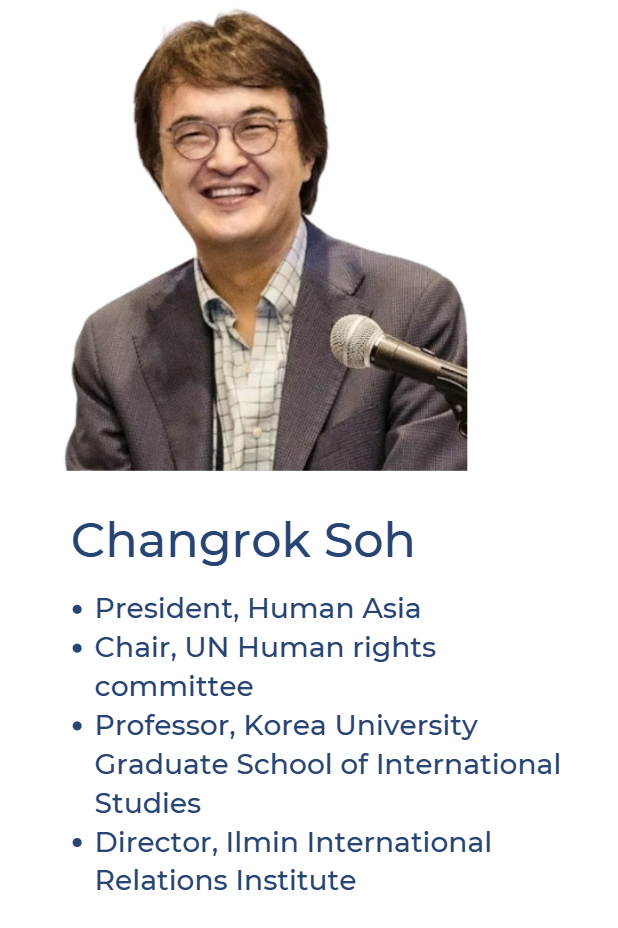
Changrok Soh, a professor at Korea University's Graduate School of International Studies, serves as the president of Human Asia, a human rights NGO, and as the director of the Ilmin International Relations Institute at Korea University.
He was elected as the first Korean member of the United Nations Human Rights Committee in 2020 and will serve until 2024.
Professor Soh is also a member of the United Nations Human Rights Council Advisory Committee, chairperson of the Korean Academic Association of Human Rights Studies, and chairperson of the Korean Academic Council on the United Nations System, and carried out the Korea Research Foundation's Social Science Research Support (SSK) project.
Professor Soh has been conducting various research projects on human rights and regional security in East Asia and has been conducting human rights advocacy campaigns for human rights promotion and community development in Asian countries.
Recent papers and books: “New Frontiers of Profit and Risk: The Fourth Industrial Revolution’s Impact on Business and Human Rights,” “The Main Challenges Related to Protecting Human Rights in the Internet” and “Business and Human Rights Case Study of Korean Companies Operating Overseas: Challenges and a New National Action Plan”.
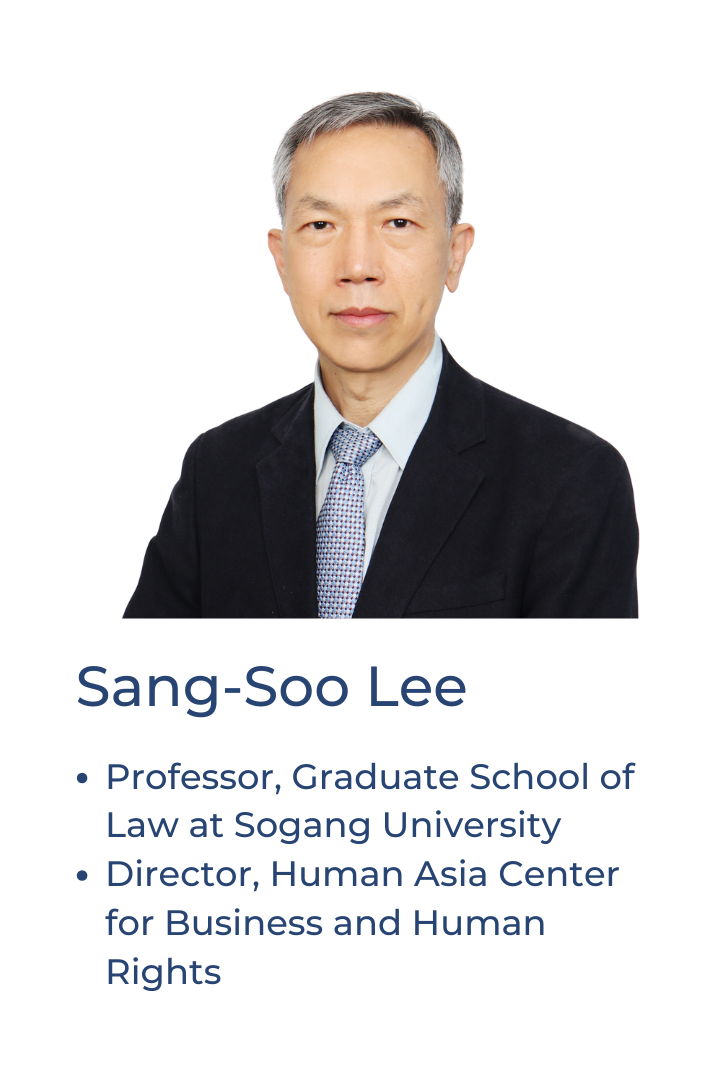
Professor Sang-soo Lee is a faculty member at Sogang University Law School, where he teaches courses in legal ethics, sociology of law, and Business and Human Rights. He previously served as Director of the Sogang Institute of Law (2018–2019) and as President of the Korean Association of Sociology of Law (2018–2019).
He earned his bachelor’s degree in law at Seoul National University, where he also completed his master’s and doctoral degrees. He has also served as a visiting professor at the National Law School of India University in Bangalore (2003–2004) and at Paris 1 Panthéon-Sorbonne University in France (2015–2016).
Professor Lee has carried out numerous government-funded research projects and published more than 20 papers on business and human rights. His work covers topics such as the UN Guiding Principles on Business and Human Rights (UNGPs), the OECD Guidelines for Multinational Enterprises, human rights violations in supply chains, corporate legal liability for human rights abuses, and various case studies. He also translated Just Business (John Ruggie, 2013) into Korean and authored the book Human Rights Management (Taehaksa, 2022).
He has long collaborated closely with the Korean government and NGOs on issues related to business and human rights. He currently serves as an advisor to institutions including the National Human Rights Commission of Korea and the Ministry of Justice on matters concerning business and human rights.
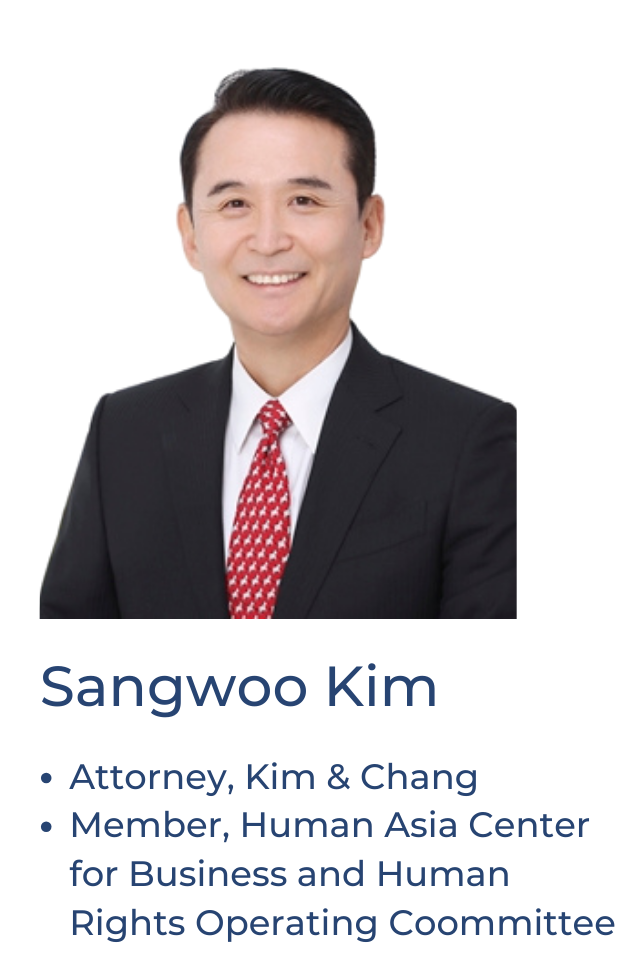
Attorney Sangwoo Kim of Kim & Chang provides legal counsel in corporate law matters, including compliance management, corporate compliance, corporate criminal law, and antitrust.
He received his LL.B. from Seoul National University and passed the 28th Korean Bar Examination, after which he completed the Judicial Research and Training Institute (18th class). He subsequently served as a prosecutor at the Busan District Prosecutors’ Office, the Gangneung Branch of the Chuncheon District Prosecutors’ Office, the Criminal Affairs Bureau of the Ministry of Justice, and the Seoul Central District Prosecutors’ Office.
In 2005, he joined Samsung Electronics, where he held positions in domestic international affairs, and served as head of the compliance team. Mr. Kim was an Executive Vice President at Samsung Electronics and served as Corporate Compliance Officer, Head of Global Legal Affairs Team at the headquarters in Suwon, South Korea, and Head of the Public Affairs Team at Samsung’s European Regional Headquarters in Brussels.
He joined Kim & Chang in 2021 and has since been providing legal advisory services on corporate matters.
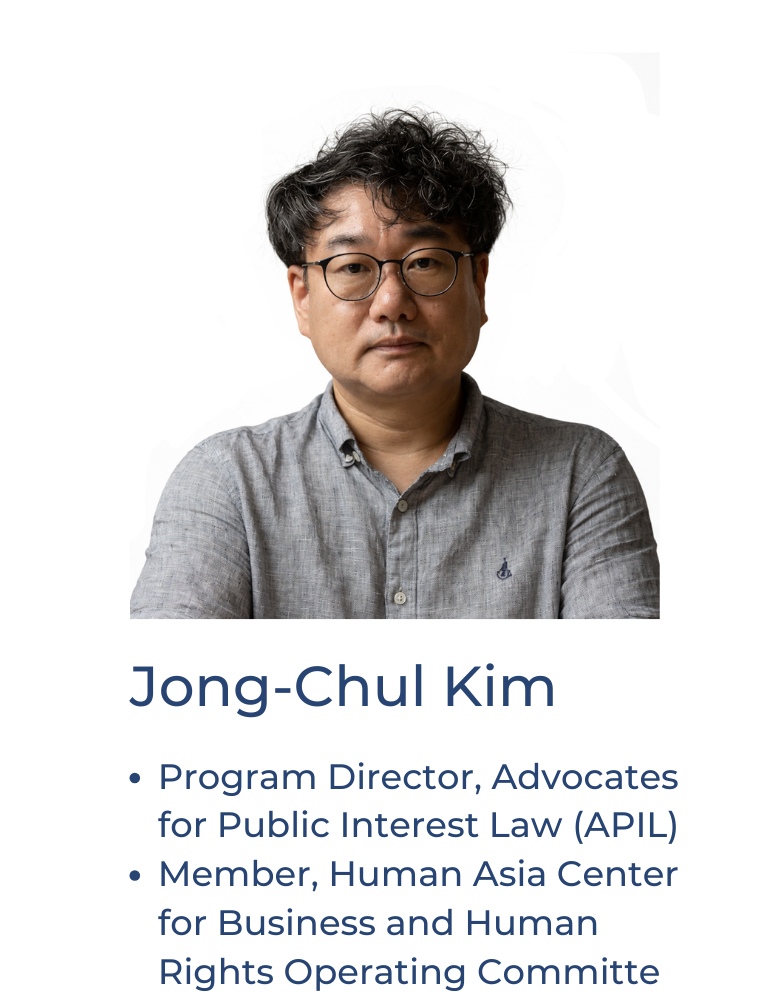
Attorney Jongcheol Kim currently serves as a Senior Researcher at the Public Interest Law Center APIL. He received his LL.B. from Korea University and completed his graduate studies in international law at the same institution. He passed the 44th Korean Bar Examination in 2002.
He previously worked at the law firm Somyung, where he was engaged in refugee support. In 2011, he founded the non-profit organisation Public Interest Law Center APIL to advocate for the rights of individuals in vulnerable situations, including detained migrants, victims of human trafficking, and refugees, as well as to address human rights abuses involving Korean companies operating overseas. He has continued his advocacy for the protection of trafficking victims and for improvements in relevant laws and policies. In recognition of these efforts, he received the TIP Hero Acting to End Modern Slavery Award in 2018.
Attorney Kim is currently engaged in efforts to protect the rights of farmers adversely affected by the climate crisis.
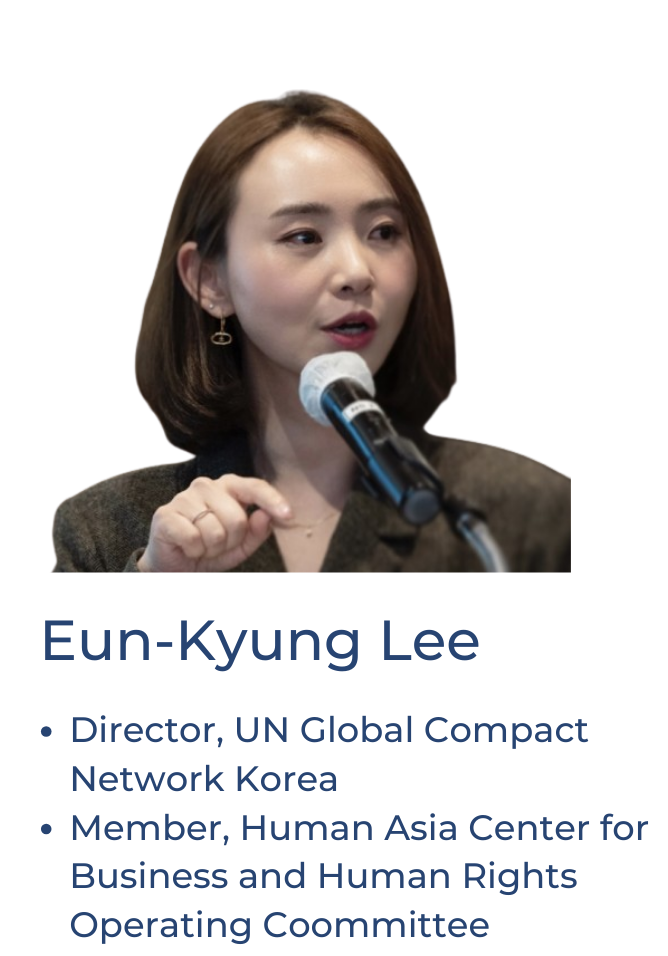
Eun-Kyung Lee, Director of the UN Global Compact Network Korea, is actively engaged in providing lectures and advisory services in the fields of business and human rights, gender and DEI, and compliance.
She also works to build a corporate sustainability ecosystem by collaborating with a wide range of stakeholders, including the National Assembly, government bodies, academia, and civil society, while supporting companies in developing and effectively implementing ESG strategies.
She serves as Co-Secretary General of the National Assembly ESG Forum, Advisor to the Human Rights Management Forum of the National Human Rights Commission of Korea, Director of B Lab Korea, and Advisor to the Daishin Economic Research Institute. She has also served as an ESG advisor to organisations including Doosan Corporation, POSCO E&C, LG Energy Solution, Seoul Housing & Communities Corporation (SH), KOTRA, and KOICA.